Article by Merle Edington
The signal came without a word.
Our tracker, Lucky, dropped into the tall grass so suddenly it looked as though someone had pulled him underground. Behind him, PH Jan Loots froze and motioned for the rest of us to do the same. Within seconds, all four of us were lying motionless in the winter grass of South Africa’s Limpopo Province, less than thirty yards from two mature Cape buffalo.
We couldn’t yet see them. That was the greatest lesson of the hunt.
Cape buffalo are among the largest and most dangerous animals in Africa, weighing close to a ton, yet they possess an almost unbelievable ability to disappear. In the tangled thornveld near the Botswana border, a buffalo can vanish behind what appears to be little more than a patch of brush.
The final thirty yards would ultimately last only a few seconds. Getting there took six days.
Limcroma Safaris operates in some exceptional buffalo country. Cool winter mornings and sprawling stands of mopane, umbrella thorn, scrub, and thick brush create everything a Cape buffalo needs to remain unseen. It’s beautiful country, but it demands patience. Success isn’t measured in miles walked or hours spent afield. It comes from making the right decisions when opportunities finally present themselves.
Although this was my third safari to South Africa, Cape buffalo are unlike anything else I’ve hunted. Their reputation for danger is well deserved, but what impressed me most wasn’t their aggression. It was their uncanny ability to disappear. Time and again, Lucky knew they were there long before the rest of us ever caught a glimpse of them.
Fortunately, we were hunting with people who had devoted their lives to mastering the bush. Our professional hunter, Jan, brought years of dangerous game experience and the quiet confidence that comes with it. Our tracker, Lucky, had been tracking game since childhood. Watching Lucky work was like watching someone read a book no one else could see. A faint track in the sand, a freshly broken twig, or a blade of grass bent in an unexpected direction told him where the buffalo had been, how many were traveling together, whether they had stopped to feed or bed down, and often where they were headed next.
From the very first morning, it became clear this hunt wasn’t going to be won by covering miles. It would be won by trusting the judgment, patience, and experience of the men leading it. Every day followed much the same rhythm. Before first light, we gathered for breakfast at the lodge, then headed into the bush while Africa was just beginning to wake up.
The objective wasn’t to find buffalo. It was to find where they had been only hours before.
Lucky stood on the rear platform of the Land Cruiser as we slowly worked the maze of sandy roads that crisscrossed the property like a giant checkerboard. To me, every stretch of road looked identical. Lucky saw something entirely different: a story written in the sand. Jan and Lucky communicated almost entirely through whistles, hand signals, and quiet conversation, stopping frequently to study the ground before deciding where to go next.
Once fresh buffalo tracks were located, the process became part science and part instinct. By determining where the herd had crossed, and just as importantly, where they hadn’t, Jan and Lucky could often narrow the search to a surprisingly small area before we ever stepped out of the truck. Only then did the real work begin.
We walked in single file with Lucky leading, Jan just behind him, me next, and my wife, Dianne, bringing up the rear. Every step had to be deliberate. Every movement had to be quiet. More than once we spent hours following tracks through the thorn brush, trusting Lucky to interpret signs the rest of us never would have noticed. Finding fresh tracks was only the beginning. Getting close enough for an opportunity without being seen, heard, or scented was where the real challenge began.
A Cape buffalo’s sense of smell is extraordinary. If the wind shifted even slightly, the hunt was over before it began. More than once, Lucky caught a fleeting glimpse of dark hides slipping through the brush while the rest of us saw nothing at all. By the time we reached where they had been, they were already gone.
For the first several days, the buffalo dictated every move we made. There were mornings when fresh tracks were easy to find, only for the wind to shift at exactly the wrong moment. Other days, we followed buffalo for hours through the thorn brush, convinced we were closing the distance, only to have them slip away unseen. One day, after nearly six hours of following fresh tracks, Lucky was convinced the buffalo were just ahead.
He was right.
We finally closed the distance enough for him to catch movement deep in the brush, but before we could improve our position, the wind betrayed us. The buffalo caught our scent and they were gone almost instantly. Unlike whitetails or elk that often stop to look back, Cape buffalo simply keep moving. Within seconds, six hours of careful tracking had come to an end. It would not be the last time the buffalo reminded us they were in control of the hunt.
For several more days, the buffalo continued to dictate every move we made. Then, finally, we caught a break. After several hours of tracking, Lucky caught sight of three Cape buffalo moving through an especially thick section of brush. For the first time all week, it appeared they had settled into a relatively small area instead of continuing to travel.
When they finally bedded down, Jan made the decision to back out. There was no safe way to move closer without risking detection, so we quietly returned to the lodge and planned to be back well before the buffalo became active again.
Several hours later, we were back in position. Lucky climbed a nearby tree to watch over the brush while the rest of us waited. Shortly after 3:00 that afternoon, he signaled that the buffalo were on their feet. Jan immediately began moving us into position, carefully working the wind and anticipating where they would emerge.
It was a sound plan. The buffalo had other ideas. Instead of continuing through the opening Jan expected, they walked only a short distance before bedding down again in even thicker cover. There was no safe way to approach them, and with daylight fading, once again the buffalo had won.
The following morning began much like the others. Lucky found fresh tracks early, and before long Jan was confident the buffalo had remained within a relatively small area. We left the truck behind and quietly picked up the trail on foot. As always, Lucky led the way. The farther we walked, the slower we moved. Every few steps, Lucky stopped to study the ground before moving forward again. Without anyone saying a word, it was obvious we were getting close.
Then, without warning, Lucky disappeared into the grass. Jan immediately motioned for the rest of us to do the same. Two Cape buffalo were bedded less than thirty yards away. We couldn’t yet see them. With the wind finally in our favor, all that remained was to wait. For the next ninety minutes, no one spoke. No one moved any more than absolutely necessary. Lucky gradually worked his way a little closer until he could confirm the buffalo were still exactly where he expected them to be. Finally, he looked back and gave Jan a subtle signal. They were on their feet. Jan quietly eased me into position as the two bulls stepped through a narrow opening in the brush.
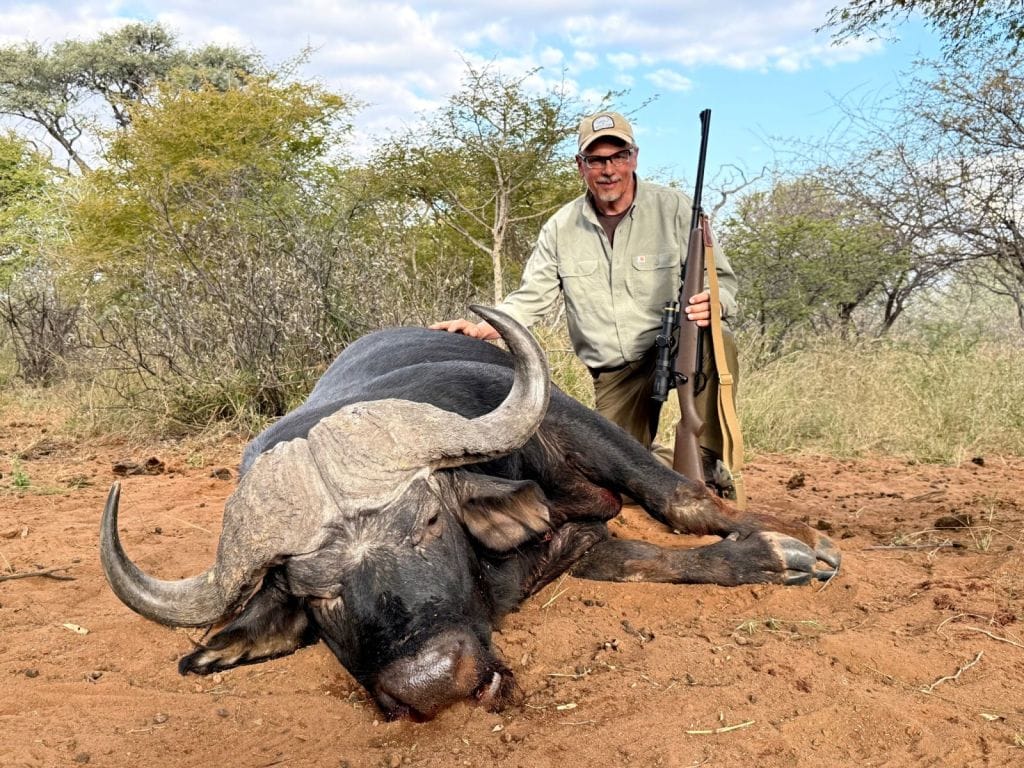
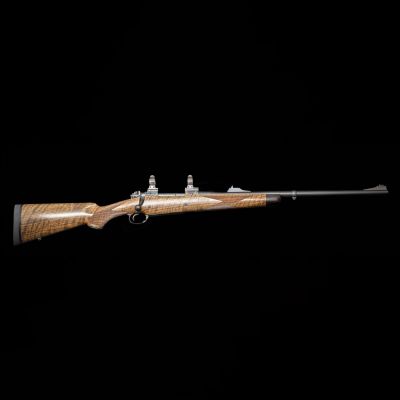
For this hunt, I carried a Parkwest Arms Savanna chambered in .416 Rigby. It was the same rifle I had carried on my first successful Cape buffalo hunt last year, and there was never any question it would make the trip back to Africa with me. It was a rifle I trusted completely and one that had earned that trust long before we arrived in Africa.
The larger of the two bulls stepped into a small opening with his head turned away, completely unaware we were there. It was the opportunity we’d been waiting for. The trigger broke, and the shot landed exactly where it needed to. Still, no one moved.
Cape buffalo have earned their reputation for incredible toughness, and a well-placed shot doesn’t always mean the hunt is over. Rather than taking up the trail immediately, Jan chose to wait, giving the buffalo time to succumb to the shot. By then, we all knew how he measured time.
Three cigarettes.
Only then did we begin following Lucky once again. For nearly an hour, he tracked the wounded bull through increasingly dense brush. Eventually, it became clear the buffalo had begun circling through a relatively small area instead of continuing on. None of us knew exactly where he was. Or whether he knew exactly where we were. Jan wasn’t willing to take that chance.
We carefully made our way back to the truck, where Jan called fellow professional hunter Martin to assist. When he arrived, he brought his Jack Russell terrier, Diesel, whose job was to help locate the buffalo before anyone entered the thick brush. As we prepared to head back in, Jan made one more decision. He asked my wife, Dianne, to remain at the truck. There was no reason for her to accompany us into that situation. The three of us disappeared back into the thorn brush while she waited.
For the next forty-five minutes, Lucky continued tracking as we moved slowly through the dense cover. Every step demanded caution because none of us knew exactly where the wounded buffalo was waiting. By then, it had been nearly three hours since my shot. We were confident it had been well placed, but Cape buffalo have earned their reputation for toughness. Even after all that time, we couldn’t assume the bull was down, or even unable to fight. Then, Diesel’s alert told us everything we needed to know.
Jan carried a double rifle chambered in .500 Nitro Express. Martin carried a CZ chambered in .375 H&H. I carried my Parkwest. The three of us stood only a few feet apart. In thick brush, no one wants to wonder where the others are once the shooting starts. Every member of our team carried equipment they trusted without hesitation. In dangerous game hunting, confidence in your equipment isn’t a luxury. It allows you to devote your full attention to the decisions that matter most.
The wounded bull was standing in the brush with his head turned away, completely unaware we were there. Then something changed. Whether he caught our movement or our scent, we’ll never know. He turned toward us, dropped his head, and charged.
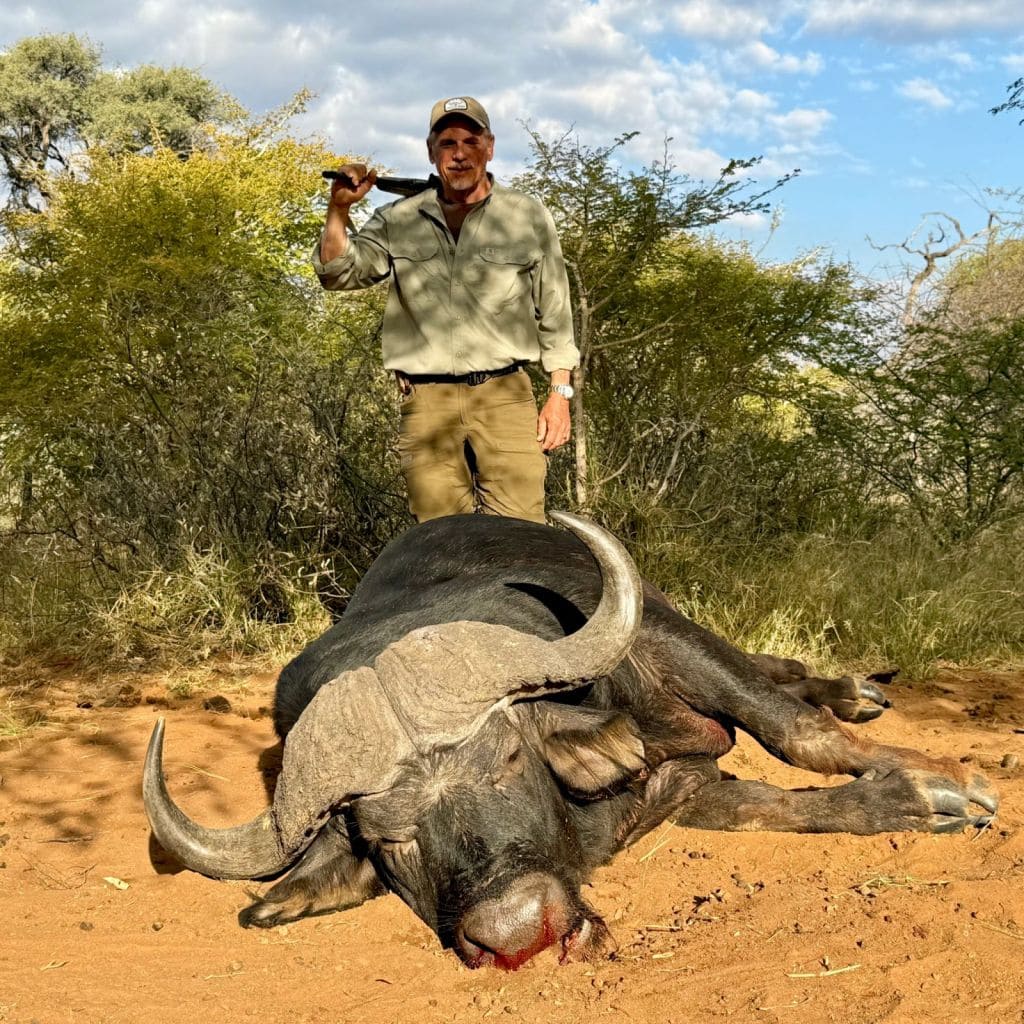
There was no time to think. I fired three times. Jan’s .500 Nitro Express answered immediately with two shots. Martin’s .375 barked twice in quick succession. The buffalo kept coming. I fired one final shot. Only then did he collapse.
Nine yards away.
Dangerous game has a way of stripping everything down to the essentials. When a Cape buffalo is closing the distance, there is no time to wonder whether your rifle will feed, fire, or cycle the next round. It simply has to work. My Parkwest performed exactly as I knew it would, allowing me to focus entirely on the buffalo instead of the equipment.
Silence returned to the bush almost as quickly as it had been interrupted. Only then did everyone take a breath. The danger had passed, but the work wasn’t finished. Recovering a Cape buffalo from thick thorn brush is a challenge in itself. Like everything else we’d experienced that week, it wasn’t accomplished with sophisticated equipment. It took experience, ingenuity, and teamwork. An aging tractor, a trailer that first needed a quick welding repair before it could even be used, a hand-cranked winch, and several willing hands eventually brought the bull out of the bush. Watching everyone work together was another reminder that a successful safari depends on far more people than the hunter behind the rifle.
Looking back, the memories that stay with me aren’t measured in inches of horn or photographs taken afterward. They’re measured in six mornings of following Lucky through the thornveld, in Jan’s steady judgment when patience mattered more than action, and in the quiet confidence shared by everyone on the team when circumstances became unpredictable.
The final thirty yards lasted only seconds.
Everything that mattered happened before them. For me, that’s what Cape buffalo hunting will always represent: patience over urgency, trust over ego, and the confidence that comes from being surrounded by experienced professionals while carrying equipment you never have to question when the moment finally arrives.