By C. Dustin Bomley
“Nothing in wild Africa dies a peaceful death,” were the words I heard from our game scout, Dean.
Two close friends and I had traveled to South Africa’s Timbavati region for ten days of hunting with Mike Birch’s Hunt the Sun Safaris. Our quarry was the elusive Dagga Boy Cape buffalo.
Timbavati is a free-range, fair-chase hunting area with low fencing that opens into the greater Kruger National Park. Located in Limpopo Province along the border with Mozambique, the region is home to an abundance of predators. Here, nothing escapes the reach of natural selection—not even humans.
Several days into our trip, after logging countless miles in the Land Cruiser, learning the terrain, and enduring several unsuccessful stalks, the day was slipping away. We were making our way back toward camp when Dean’s calm voice broke through the low drone of the engine.
“Mike, there’s a lone Dagga Boy bedded back there.”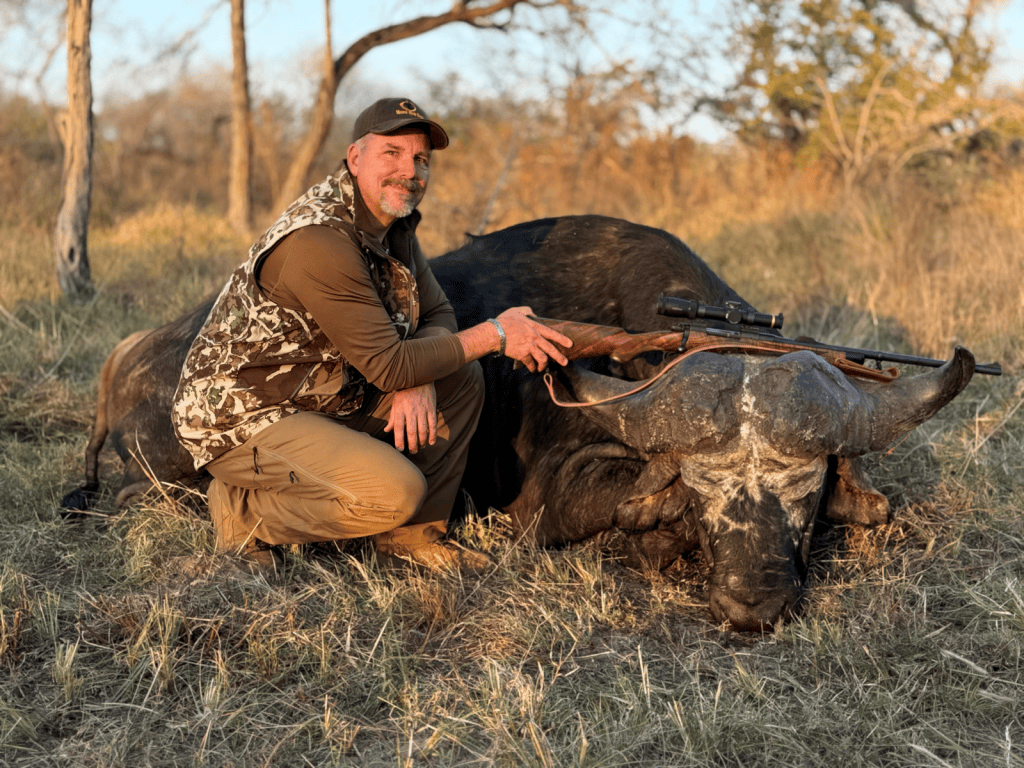
Instantly, the Cruiser came alive. The brakes squealed as the vehicle slowed on the dusty two-track, and everyone shifted to look in the direction Dean had indicated. Mike quickly raised his binoculars, studied the area, and nodded.
“We need to look this one over,” Dean told him.
The bull lay several hundred yards off the track, bedded in a narrow opening between tall grass and mopane trees. How Dean had spotted him in that tangled landscape is something I’ll always wonder about. After glassing the animal from a distance, Mike and Dean agreed that the bull warranted a closer look.
By the time I climbed down from the Cruiser’s elevated gun rack and retrieved my rifle, Mike, Dean, and two trackers were already moving carefully through the cover, searching for the best route to our quarry. We had less than two hours of daylight remaining.
I caught up with Mike, and together we watched the bull settle back into his bed from several hundred yards away. With the wind in our favor, we began closing the distance, working slowly toward a position where Mike and Dean could comfortably evaluate the animal.
Conservation and game-management practices are taken seriously in this region. We were looking for a mature bull past his prime breeding years, while also ensuring he met the strict size requirements for harvest.
Once we had closed to within 50 yards, Mike and Dean agreed that this Dagga Boy qualified.
We moved a few yards closer, and Mike set up the shooting sticks for my Parkwest Arms .375
H&H rifle.
At just 42 yards, the bull remained bedded. I settled behind the rifle, searching through the grass for a glimpse of his shoulder. Unable to see enough of the animal to make a shot, I turned to Mike.
“What now?”
Mike calmly replied, “We wait.”
He explained that, in his experience, most buffalo would rise to adjust their position or move around every twenty minutes or so.
With my rifle poised on the sticks, the stock pressed firmly into my shoulder and my cheek welded to the stock, I waited.
And waited.
And waited.
Twenty minutes passed. My lower back tightened, and I shifted my feet ever so slightly to keep the blood flowing. My feet and ankles began to tingle and fall asleep from standing in one position. I glanced intermittently at my Garmin watch, which showed my heart rate holding steady at 139 beats per minute.
Every movement the buffalo made—a turn of his head or a swish of his tail to discourage birds from landing on his back—sent me refocusing through my Leupold 1–6x scope. Thirty minutes passed. Then forty.
At the forty-five-minute mark, Mike leaned toward me and whispered that we would give the bull five more minutes.
I still couldn’t tell exactly how he was lying. When he finally stood, would he be quartering toward us or away? Would he offer a broadside shot, face away, or turn directly toward us?
Would the light fade before he rose, forcing us to abandon the stalk?
The questions crowded my mind, and my heart continued to race.
At minute forty-eight, every distraction—the numbness in my feet, the ache in my lower back, the passage of time—vanished.
The old Dagga Boy shifted and, with startling speed, surged to his feet.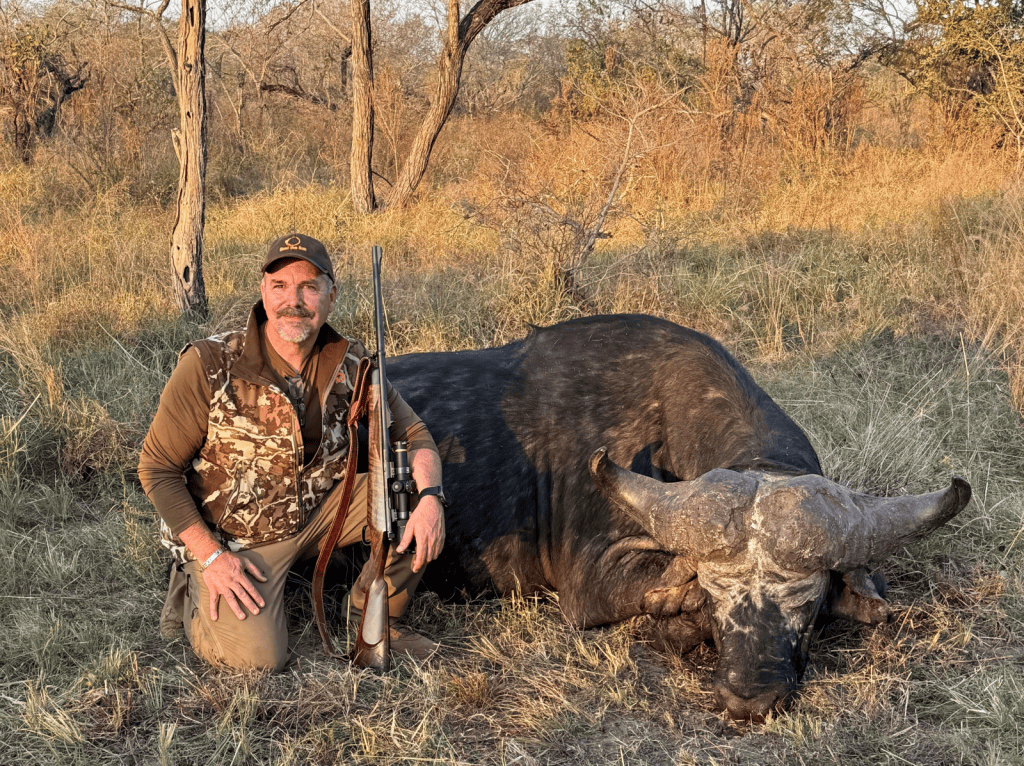
He was facing me.
Straight on, head lowered, he offered no shot.
Mike whispered one word:
“WAAAAIIITTT!”
His .470 Nitro Express and Dean’s .458 Winchester Magnum were trained intently on the space between the eyes of the curious but clearly agitated giant. I held my crosshairs on the buffalo’s chest, hoping he would move just enough to expose a shoulder.
That was exactly what happened.
The bull shifted his lowered head slightly to the left and took two short steps, exposing his right shoulder. I settled the crosshairs and squeezed the trigger.
The report of my Parkwest Savanna .375 H&H shattered the silence.
Everything unfolded in slow motion. The 270-grain Barnes TSX struck the bull at the point of his right shoulder, and he lunged forward. He took two powerful leaps toward us before turning sharply to his left, as if trying to escape whatever had just stung him.
As the buffalo wheeled to run, Mike yanked the shooting sticks from beneath my rifle and
shouted, “Come, come, come!”
My feet were still numb from standing motionless for so long. I managed three short, awkward steps before the western elk hunter in me took over. I wrapped my arm into the leather sling, pulled the stock firmly into my shoulder, and swung onto the left front shoulder of the fleeing buffalo.
My second shot broke loose.
As I recovered from the recoil, I heard Dean shout, “Great shot!”
The second bullet had struck just behind the shoulder as the bull quartered away. The impact sent him tumbling. He crashed into the earth and a small mopane tree, sending leaves and dust exploding into the evening air. To me, it looked like a cloud of chaos.
Again came Mike’s emphatic command.
“Come, come, come!”
We moved around behind the old solitary bull. He let out a deep, heavy death moan, but Mike instructed me to place one more round between his shoulder blades.
Every experienced buffalo hunter knows the old saying: “It’s the dead ones that kill you!”
I had no hesitation about following Mike’s instructions and placing one final insurance shot.
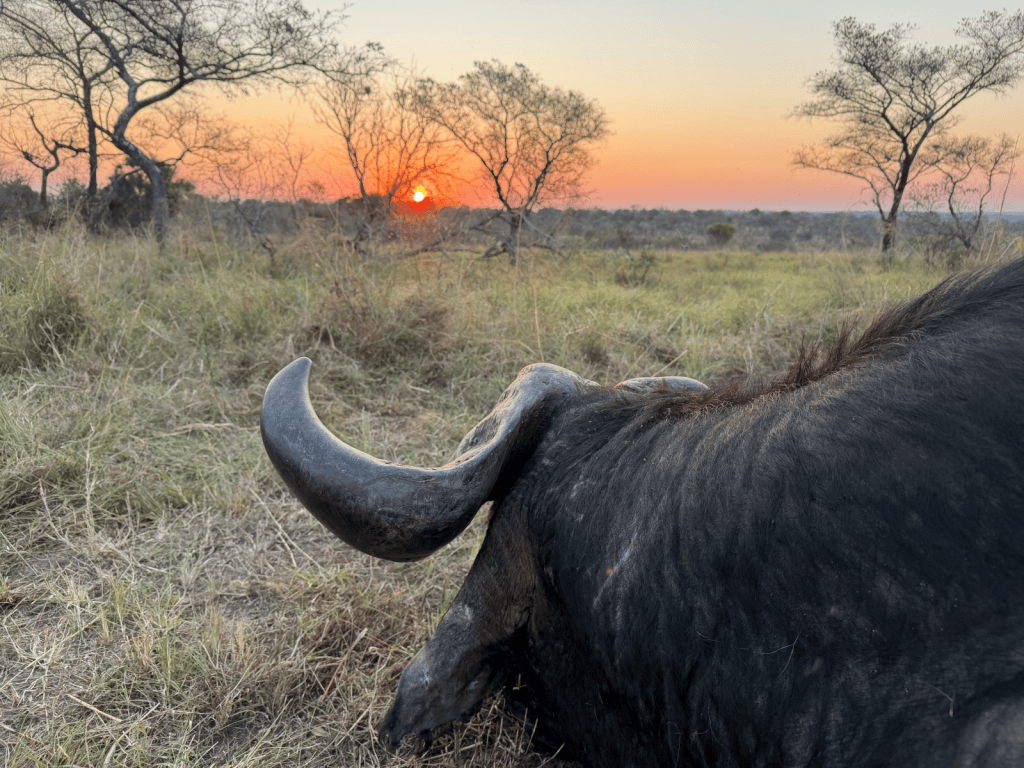
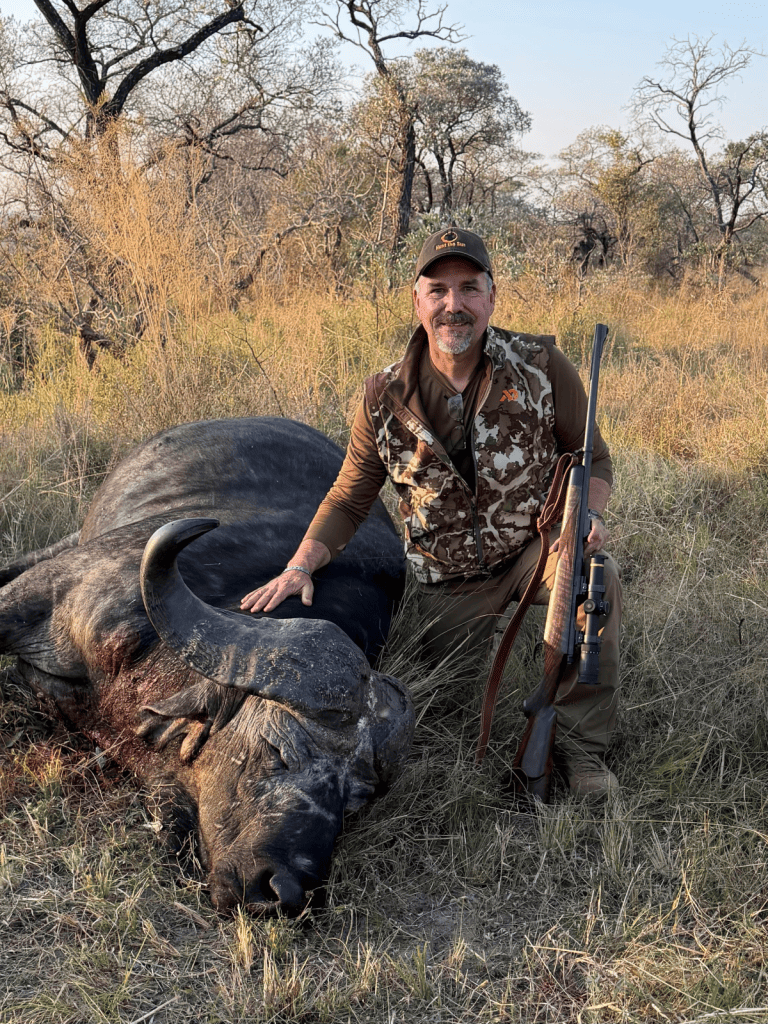
At last, my first Cape buffalo—a true Dagga Boy—lay before me.
My knees began to tremble. My hands grew clammy, and my heart rate peaked in the high 140s.
I walked forward to admire the battle-scarred warrior I had just taken.
His bosses were battered and broken, the tips of his horns broomed off, and his ears shredded.
Even his left hip bore the unmistakable scars of lion claws.
As I studied those scars and the weathered evidence of a hard life, Dean’s words came back to me.
Nothing in wild Africa dies a peaceful death.
Standing over that old warrior, I understood just how true those words were.
Now that I’ve experienced the adrenaline rush of hunting what many call “Black Death” and taken such an extraordinary old Cape buffalo, I know I must return.
This is not a once-in-a-lifetime hunt. It is something that gets deep into your bones. The tension, the uncertainty, the raw power of the animal, and the thrill of facing such a formidable quarry leave an impression that refuses to fade. The desire to experience it again burns deep within me.
I will return to Africa, once again scanning the shadows beneath the mopane trees, searching for another Dagga Boy.